



Chun-Wei Huang, Taiwanese Liquid-Metal Breakthrough Published in Nature Communications
2026/01/14 | By Sherry Chen– Leading a cross-institutional research team to achieve a major breakthrough in liquid-metal technology, enabling rapid, room temperature synthesis of bimetallic metal-organic frameworks (MOF), highlighting Taiwan’s advantage in advanced material research.
Chun-Wei Huang, associate professor in the Department of Materials Science & Engineering at Feng Chia University (FCU), has led a cross-institutional research team with Wen-Wei Wu, professor of Material Science at National Yang Ming Chiao Tung University to achieve a major breakthrough in liquid-metal technology, overcoming longstanding limitations in electrodeposition to enable rapid, room temperature synthesis of bimetallic metal–organic frameworks (MOF). Research findings were later published in the international journal Nature Communications, highlighting Taiwan’s growing advantage in advanced materials research.
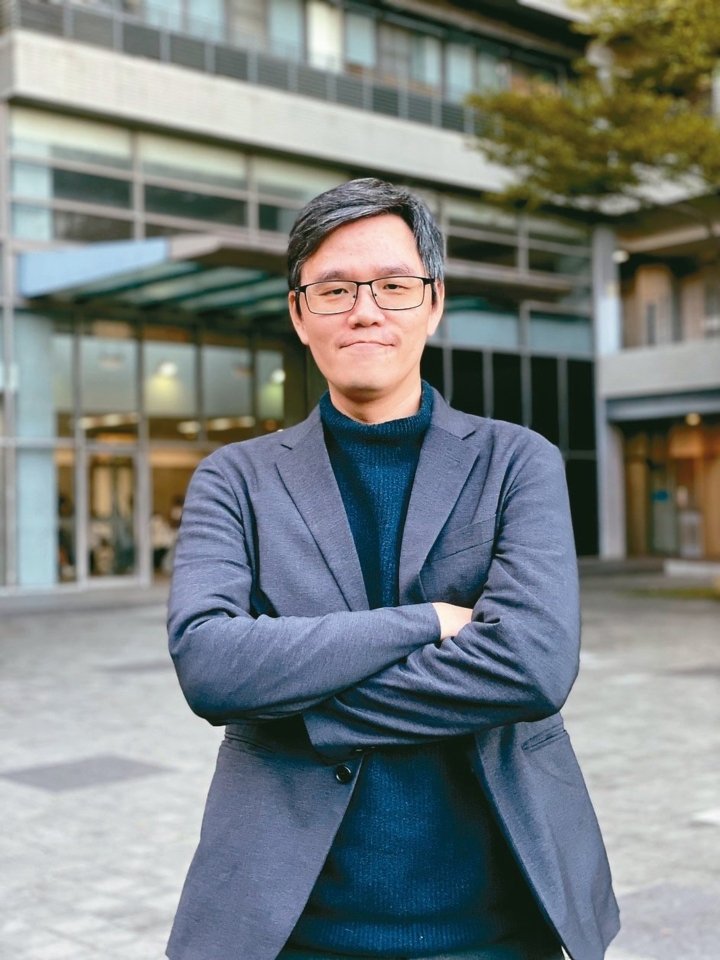
The research focuses on gallium-based liquid metal as the anode. Leveraging its self-healing properties and stable release of metal ions, the method enables Mg²⁺ and Zn²⁺ ions to be released simultaneously under an electric field and to co-assemble into suspended ZnMg-MOF-74 structures. The approach resolves key challenges associated with solid anodes, including passivation, the dissolution of only a single metal species, and material growth confined to electrode surfaces. The technique opens a new pathway for electrochemical synthesis of multi-metal MOFs and provides a versatile strategy for rapid synthesis, advancing potential applications in optoelectronics and sensing technologies.
As for research application, material innovation can be actively translated into semiconductor, energy, and sustainability sectors. Through transmission electron microscopy and atomic-scale analysis, Professor Huang has developed dynamic models of metal-oxide interfacial reactions to improve device reliability. He has also designed novel structural materials capable of carbon dioxide capture and conversion, addressing net-zero emissions and circular-economy objectives.
In industry–academia collaboration, Professor Huang notes that the most consequential industrial limitation often requires cross-disciplinary perspectives and long-term experience. He currently works with research institutes and companies across the semiconductor, materials, and energy industries, spanning material synthesis, analytical measurement, and device integration, while focusing on cultivating a new generation of engineers with integrated materials and process expertise.
Professor Huang brings extensive cross-sector research experience, having previously worked at Academia Sinica, the Industrial Technology Research Institute, and TSMC, with solid practical foundations in materials development and process integration. Since returning to academia, he has led multiple projects funded by Taiwan’s National Science and Technology Council and industry partners, and has been awarded the NSTC’s “2030 Cross-Generational Young Scholar Program (Outstanding Young Scholar)” grant. His paper, “Synthesis of Bimetallic MOFs via Interface Control Using Gallium-Based Liquidmetal,” is regarded as a significant milestone for Taiwan in liquid-metal chemistry and functional materials technology.