



Taiwan Drone Alliance Expands to the U.S. Market, Accelerates Global Alignment
2026/01/23 | By Sherry Chen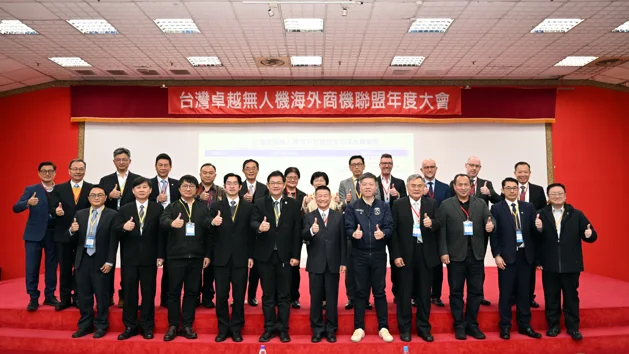
The Taiwan Excellence Drone International Business Opportunity Alliance (TEDIBOA) has set its sights on the United States as its top priority market in 2026, focusing on helping Taiwanese manufacturers secure U.S. certifications and integrate into international supply chains.
Established in September 2024 under the Ministry of Economic Affairs, the alliance held its first general assembly yesterday to review progress and outline its strategic roadmap. Convened by the Aerospace Industrial Development Corporation (TWAIDC), the alliance’s membership has expanded rapidly, with more than 260 companies. Under the leadership of the alliance Chair and AIDC Chairman Chin-ping Tsao, TEDIBOA aims to lead Taiwanese drone suppliers into the global market, especially the United States. Under these efforts, the alliance has forged partnerships with 11 drone organizations across seven countries. This year, delegations are planned for Singapore, South Korea, and Malaysia.
A key objective of the alliance is to obtain U.S. regulatory approvals for its members. In response to new Federal Communications Commission (FCC) requirements, drone products must pass Green UAS or Blue UAS certification this year to avoid export restrictions. The alliance is working with ITRI on two parallel strategies: introducing authorized U.S. certification pathways by the end of January, and replacing direct subsidies with certification guidance to reduce compliance costs while avoiding potential dumping or unfair competition.
As global trends shift strategically toward “non-red” (non-Chinese) supply chains, the TEDIBOA alliance has compiled a comprehensive list spanning the full spectrum, from complete system assembly to mold and component manufacturing, thereby connecting Taiwan’s upstream and downstream supply chains in the aerospace industry. This strategic system significantly enhances Taiwan’s competitive advantage. Chairman Tsao also emphasized that the shared goal is to consolidate Taiwan’s industrial strengths, transforming fragmented technologies into a global competitive advantage with a “non-red” supply chain.