



AI and EV Power Demands Push Taiwan’s Measurement Equipment Industry Upmarket
2026/01/30 | By Sherry ChenThe rapid expansion of electric vehicles and artificial intelligence servers is redressing the technical demands on the global electronics industry, particularly in the testing of power systems and magnetic components. Higher power density, lower energy loss, and greater operational stability have become baseline requirements for next-generation electronic systems, raising the technical threshold for measurement equipment in areas such as high-current handling, high-frequency performance, and operational safety.
Compared with conventional low-power testing environments, inductors, transformers, and power devices used in AI and EV applications must now be validated under far more stringent current and thermal conditions. This shift is leading the measurement equipment sector towards high-power testing closer to demanding operating conditions.
In AI systems, power architectures are required to manage multiple high-power modules simultaneously while maintaining energy efficiency and low electrical noise under dense computational loads. In EVs, power-conversion efficiency and component durability are directly linked to system safety and driving range. As a result, magnetic component testing is increasingly designed around actual operating currents, with direct-current bias (DC bias) testing emerging as a critical method for assessing magnetic saturation and thermal behaviour. It is becoming a standard tool to verify high-power magnetic components.
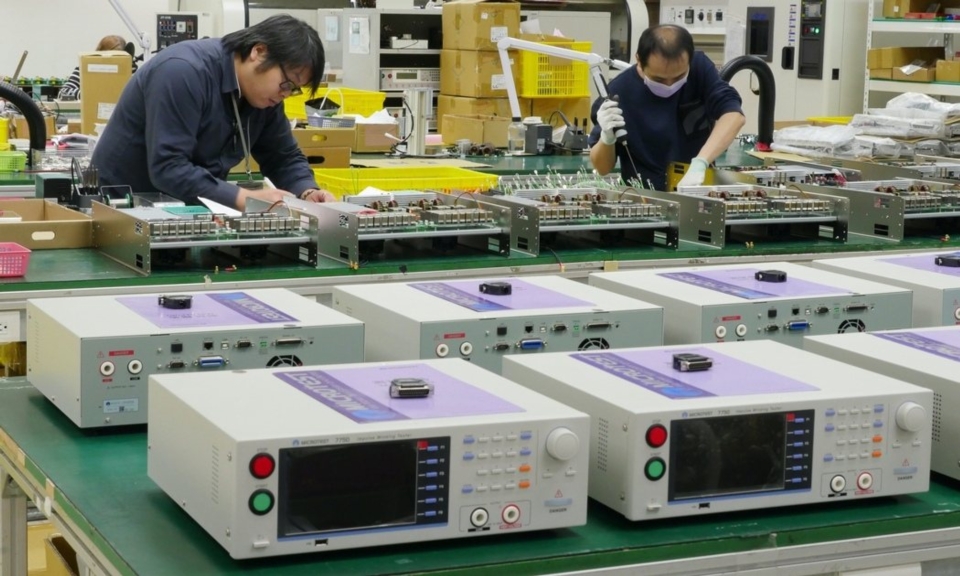
Historically, the high-end measurement equipment market has been dominated by European, American, and Japanese suppliers, with Taiwanese firms largely positioned in production line applications and system integration. However, the advance of manufacturing automation and high-power electronics is driving demand for greater measurement accuracy, repeatability, and safety. This has prompted Taiwanese manufacturers to invest in proprietary high-frequency, high-current test architectures and to shift from function-based upgrades towards system-level engineering validation.
In this context, Microtest has emerged as one of the local manufacturers of measurement equipment, investing in high-current test platforms that offer systems capable of supporting DC bias currents of up to 640 amperes. Such developments reflect a broader transition within Taiwan’s measurement-equipment industry, from manufacturing support towards design testing for high-power applications in AI servers and automotive electronics, marking its entry into system-level validation for next-generation power technologies.