



Office FurnitureAdding Value to Stay Competitive
2005/06/15 | ByThough competition is growing, Taiwan retains a strong position in the international market for office furniture, helped in large part by the industry's wholesale migration to mainland China, Vietnam and other lower-cost production sites.
Friedrich Chen, chairman of the Taiwan Furniture Manufacturers' Association, says Taiwan has proven especially adept at tapping niche markets for metal furniture, office and home furniture, and furniture with unique designs.
Chen is also president of Taiwan's Fine Year Woodwork Co., which several years ago set up subsidiary Homedecor Worldwide Co. to produce mainstream furniture items in Dongguan, mainland China. The parent company still produces high-end office furniture in Taiwan, capitalizing on the island's reputation for quality.
Despite the mass exodus of wood-furniture manufacturers from Taiwan, Chen notes that several producers have remained rooted on the island. To make up for the cost disadvantage they face, these manufacturers have focused on higher-margin specialty items turned out in relatively small volumes. They have also bolstered their design ability to smooth the evolution from original-equipment manufacturer (OEM) to original-design manufacturer (ODM) production.
Nice Legs
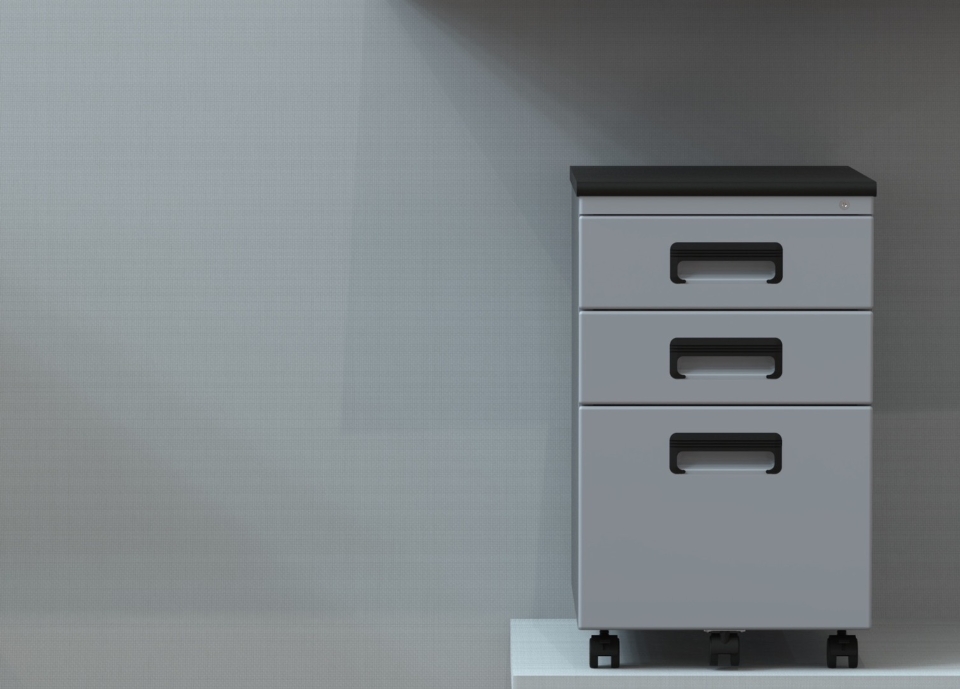
Sunburst Furniture Co., Ltd. Is one of Taiwan's leading manufacturers of key furniture components and parts, with a specialization in high-quality metal legs for desks, conference tables and coffee tables.
In recent years, the company has added new steel components for partitions and office furniture to its product line, says Sunburst president Lloyd B. Palangeo. "We have also developed a complete range of curved-front desk-high and mobile pedestals, " he adds.
The company has a plant in Donggang, in Taiwan's far south. The factory has adopted a strict quality-control system to ensure the high quality of its products, all of which are exported.
"To ensure the high quality of our products, our plant focuses on such critical operating processes as coating, packaging and delivery jobs, " says Palangeo. "Currently we cooperate with three well-experienced sub-factories which specialize in mold fabrication and such manufacturing processes as metal cutting, bending, polishing and welding."
Palangeo says his company specializes in making steel parts for wood furniture. "Our table legs and pedestals can perfectly match any desk or workstation to create a comfortable office working environment, " notes Palangeo.
One of the company's hottest-selling items is the Smart desk series. "Our Smart-series is a perfect fit for office furniture, computer desk, and household furniture manufacturers that need adaptable and comprehensive desk-system solutions, " Palangeo says.
Sunburst says its Smart desk/table legs have passed BIFMA testing. The flexibility of the Smart components allows furniture manufacturers to configure and redefine office space.
Struggling With Materials Costs
Another manufacturer focusing on office furniture is Chuan Lin Wang Co., Ltd., which specializes in the production of office chairs and chair parts/components.
Despite its fast growth in the past few years, the company worries that rising materials costs could hit profits. It primarily uses steel and PU (polyurethane) leather. The price of the latter has risen over 40% in the past year. Recent appreciation of the New Taiwan dollar has also hurt this export-driven firm, which ships 45% of its output overseas.
To help reduce the impact of rising costs and the stronger local currency, the company plans to focus production capacity on making office chairs, which yield a higher profit margin than do parts and components.
Pot of Gold in Rainbow Brand
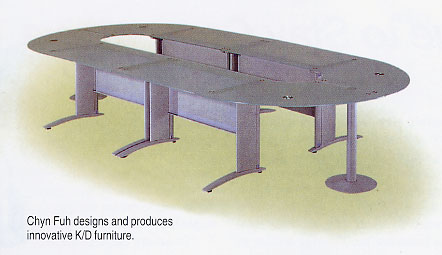
Chyn Fuh Enterprise Co., established in 1993 in southern Taiwan, specializes in the manufacture of knock-down (K/D) office furniture and system furniture, with a particular focus on office and computer desks.
The company's "Rainbow" brand system furniture has been a hot-seller in the international marketplace, helping the company double revenue annually over the past several years.
The company exports products to more than 50 countries, including the U.S., Japan, Germany, and Italy. A reputation for innovation and quality, the company says, has helped its success in these demanding markets.
Chyn Fuh's quality gains have come in part from its integrated production ability, which now ranges from mold making through the assembly of whole-set furniture. "In our early years, a lot of furniture makers in Taiwan still relied on the support of satellite factories. But we moved rapidly to establish an integrated production facility in Taiwan, " says Chang Ching-chang, president of the company. "This helps us to keep costs down and allows us to fully control the quality of our products and our delivery schedule."
Chyn Fuh uses semi-automatic production equipment, including pressing machines with progressive molding ability, to turn out its office furniture, computer desks, and other innovative products. "These machines have significantly reduced the time needed to change molds, " Chang says.
Chyn Fuh has also built up a reputation for making products that are ergonomic, attractive, and easy to assemble.
"With the help of our six-person design team, " says Chang, "we've won at least 25 patents in Taiwan, Japan, mainland China, the U.S., and Germany. Right now we are applying for several design patents in Taiwan."
The company's products are finished with static-electricity powder coating processes and go through a nine-step rustproofing process, says Chang.
Chang says sophisticated molds have contributed much to the company's success. "When other domestic manufacturers in this line were still focusing on old items about a decade ago, we were working hard to develop the sophisticated molds needed to make innovative products."
The company's furniture is designed for easier and more compact shipment. "We can fit 360 filing cabinets into a 40-foot container, compared to only 120 by other companies."
Among Chyn Fuh's most recently developed products is a fourth-generation office partition with steel structure. "This new product is unique in the Taiwan market, " says Chang. "The continuous development of new products helps us to sidestep harsh price competition. In addition, we have boosted our order-fulfillment efficiency over the past several years, distributing our new products in the international marketplace more rapidly."
Easy-to-use instruction manuals help customers assemble Chyn Fuh products quickly, Chang claims. "Other manufacturers of K/D furniture have to send people to help consumers assemble their products. Our customers can easily handle assembly alone with the help of our illustrated manuals."
Chyn Fuh currently exports 70% of its total output. The company's domestic sales are handled mainly by Aurora Furniture, a member of the Aurora Group, on an OEM basis.
Chyn Fuh has been ISO-9002 certified and uses environment-friendly, fire retardant, and noise insulating materials in its products.
"Our patented products have helped us gain strong brand recognition at leading international furniture shows in Cologne, Dubai and Malaysia."We have generated a lot of business from those shows over the past few years."
Chang says he is not so worried about rivals in mainland China and other developing nations copying his company's furniture designs. "By continually developing new products, " he explains, "we've been able to keep ahead of the mainland copycats. We have a strong ability to develop unique products, and we spend a lot of money obtaining patents to protect them."
With foreign orders flooding in, the company recently inaugurated an 180, 000-square-foot plant in Pingtung County to produce office furniture. The new facility now concentrates on the development and manufacture of large-sized office furniture items, including iron cabinets, screens and partitions that can be assembled without fasteners for do-it-yourself (DIY) customers.
Designing a Difference
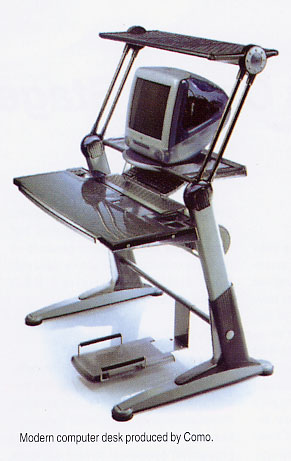
Another domestic firm with its own design capability is Como Furniture Enterprises Co., Ltd., headquartered in Taichung City, central Taiwan. The company inaugurated a new plant in Changpin Industrial Park in Changhua County in March last year.
Como was founded by Michael Ko, now president of the company, in 1989 as a mold developer. In its early years, the company concentrated on the development of small molds for chairs, desks and coke boxes, but it later expanded into the production of bigger molds for whole-set chairs.
In 1995, Como began production of self-designed furniture items, including computer workstations and other office furniture items sold worldwide under the "Comta" brand.
Extensive experience in developing sophisticated molds has smoothed Como's entry into the furniture market. Today the company turns out such items as computer desks and peripheral products, storage racks, file cabinets, television set cabinets, and chairs.
Due to its concentration on high-quality products, over the past few years the company has won awards of excellence from the Ministry of Economic Affairs and the government-backed Taiwan External Trade Development Council (TAITRA), including the "Symbol of Excellence" for Taiwan products and the Good Design Award. Ko says that his company's dedication to innovation and quality--it commits 10% of revenue and 20% of its staff to product development--have enabled it to tap upscale markets overseas.
Como supplies products to many foreign large-sized companies on an ODM basis, though OEM orders are growing. The company says its products are sold through several retail chains in the U.S. and Europe.
The company has largely automated production in order to develop more sophisticated products using self-made molds. Its production line currently includes such cutting edge equipment as plastic injection molding machines with 1, 500-ton capacity, needed to turn out large-sized plastic parts, says Ko.
Automation, Ko says, has also helped his company keep production costs low enough to compete with rivals in mainland China and other emerging furniture production centers.
Ko says his company can handle all production processes, except electroplating, in-house. "We commission a specialized plant to handle the electroplating process, but we closely inspect such work to guarantee top quality results."
Over the past few years, the company has ushered in an electronic enterprise resource planning (ERP) system, which has helped it control production costs and move toward a just-in-time manufacturing mode.